
The agent, from a buyer side
What Basetao does with your find, and what it does not
Enough about the company to judge a single purchase. Not a company profile, not a review score, and no claim about who is cheapest.
The mechanism
What actually happens to an item you order
Every step below is described on a Basetao page. What matters for a find is which step is the last one where you can still change your mind.
You hand over a link, a picture or some words
The search box takes all three. If none of them finds it, the Search for me form takes a picture URL and an item name and someone looks for you.
Basetao buys it in its own name
The help centre says orders are usually placed within 24 hours when there are no questions. This is the point where your money has left, and where the return clock has not started yet.
The seller ships it to the warehouse
Domestic Chinese shipping, usually days rather than weeks. Nothing for you to do at this stage.
It arrives, and it is photographed
Quality control pictures are normally uploaded the same day the item arrives, and you view them from the image icon next to the item. This is the first moment you see the real thing, and the first moment the seven day return window is running.
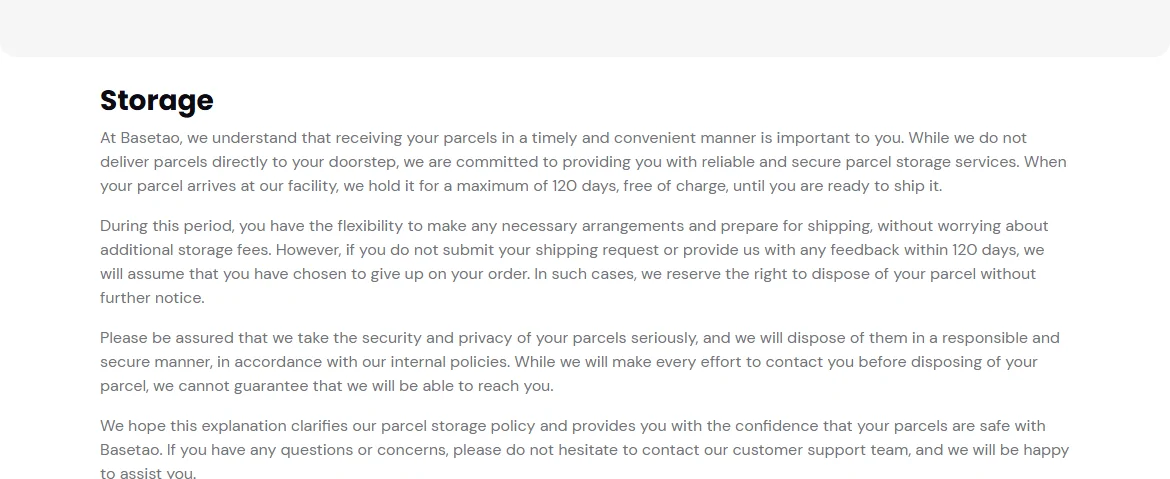
You decide, with up to 120 days of free storage
Ship now, wait for more items to combine, ask for measurements, or start a return. Storage is stated as 120 days free of charge.
It is packed and flown
Weight is recalculated at packing. Some lines use volumetric weight, measured with a triangle ruler across the longest sides, and the larger of actual and volumetric is what you pay on.
Agent or forwarder, and why the answer changes what you can undo
Buy for me means Basetao is the buyer. It talks to the seller, and when something is wrong it is Basetao that can ask for a return or an exchange, which the home page says happens only with the permission of that seller.
Ship for me means you already bought it and you are only using the warehouse. You still get arrival photos and an updated weight. What you do not get is a route back: the parcel page asks you not to use your own logistics for returning or exchanging, and states that the company has no import qualifications, so parcels sent to the warehouse from outside China are likely to be returned or seized.
For a find you are unsure about, that difference is the whole argument for letting the agent do the buying.

Why Basetao rather than another agent, and when to use something else
Start with the buying workflow, then compare Basetao’s published services and limits with the item and destination you have in mind.
The common buying-agent workflow
- Buys from Chinese platforms on your behalf and receives goods at a warehouse
- Photographs arrivals and holds them so several orders can travel together
- Charges you for the goods, for domestic shipping, and later for the flight
- Cannot make a seller accept a return, and manufactures nothing itself
- Prices in CNY and quotes freight by weight, sometimes volumetric weight
What Basetao states that is worth choosing it for
- A measurement service with a published price of 1.5 CNY, which turns the fit question into something you can buy an answer to
- An inspection standards page that names its own exclusions instead of implying coverage
- Free arrival photographs, with no charge stated for extra pictures
- 120 days of free storage, long enough to resolve a dispute properly
- A search fallback for items you can only describe or picture
When you should not use Basetao, or any agent
If the item is sold in your own country at a price you can live with, an agent adds two shipping legs and a wait for nothing. If it is on one of the two published lists, no amount of planning helps: knives, pure batteries, imitation brands, food, liquid, powder, chemical substances, flammable and explosive materials, and animal or plant specimens are named as things Basetao will not buy, and the parcel page adds gun shaped products, lighters, computers, laptops, phones and anything over 1.5 m.
If the purchase depends on the item working out of the box, read the electronics exclusion twice before you commit. And if you need it by a date, note that the stated service hours are 09:30 to 20:30 Monday to Saturday, so a Saturday evening question waits until Monday.
Who you are actually dealing with
The disclaimer on the parcel page is worth reading in full once. It says that all products shown for the shopping agent service come from third party platforms and are not sold by Basetao directly, and that Basetao does not take liability for issues caused by intellectual property or copyright infringement.
That is the honest shape of the relationship. Basetao is a buyer, a warehouse and a shipper. Whether the thing is what the seller says it is stays between you and the seller, and that is exactly why the check-point questions on this site are worth asking before you order.
Company description on basetao.com, read 2026-08-04.

A test you can reuse
How to judge a trustworthy agent you have not used yet
Everything on this page is about one agent. The method underneath it is not, and it is worth separating the two, because you will eventually look at another one.
Four things decide whether an agent can be checked at all, and all four are about what it publishes rather than what it promises. Does it publish an inspection scope with exclusions in it? Any agent will say it checks your items. The useful ones write down what the check does not cover, because that is the sentence nobody writes for marketing reasons. Does it state a storage limit and what happens when it runs out? A free storage number on its own is a selling point. A free storage number plus the disposal rule is a policy. Is there a prohibited list, and does it admit to being incomplete? Is there a route to a human, with hours?
The screenshot is the fourth check passing. Basetao writes down the order of escalation, puts a clock on it, and states what evidence it will want. You can disagree with the twenty-four hours and the seven days, but you can hold it to them, and that is the whole point of the test.
What this test deliberately does not do is score anybody. There is no honest way to rank service quality across agents, because nobody publishes comparable data on it. What you can do is check whether an agent has given you enough written material to argue with later.

Context
The other shopping agents you will also see named
Basetao is one of several dozen services doing broadly the same job, and you will meet the others in the same threads you met this one. A little orientation saves you from assuming that what is true here is true everywhere.
What usually transfers between agents: the warehouse model, free arrival photographs, combining several orders into one parcel, storage with a deadline, and a published list of things that cannot be shipped. What usually does not transfer: the length of the storage window, whether measuring costs anything, what the inspection explicitly excludes, which lines are offered, and where the money is actually made.
That last one is worth a sentence. Several agents advertise no service fee and recover it on the exchange rate instead, which is invisible unless you compare the final charge against the mid-market rate yourself. Independent fee surveys publish this agent by agent, and as of 2026-10-08 the largest of them covers thirty-four services. Basetao is not in it. That is not a mark against Basetao, but it does mean the comparison you want has to be run by you, on your own basket.
We are not going to hand you a ranking. Service, speed and how an agent behaves when something goes wrong have no public dataset behind them, and a number invented for those columns is worth less than no number at all.

Next step.
- The Basetao Spreadsheet covers the other half: where the finds come from before Basetao sees them.
- Judging a find is where this turns into a decision about one item.
From approved QC to a delivered parcel
Resolve any return or exchange before requesting final packaging. Choose the items to consolidate, keep protective packaging where needed and ask for the packed dimensions and weight. Compare routes for your destination and item attributes, including their chargeable-weight rule, tracking, declared-value requirements and claim terms.
Review the international shipping quote, packaging or insurance options and any destination charges that remain outside the invoice. An estimate made before packing can change. If a rate is CNY per 1 unit of your currency, divide the CNY total by that rate; compare the result with the amount your payment provider will actually charge.
After the shipping payment, save the parcel number and carrier tracking number. A created label does not yet prove carrier collection. For a stalled parcel, ask support which carrier event is missing and keep the written reply.
At delivery, check the package condition and contents. Photograph damage, the label and the affected item, retain packaging and report the issue within the applicable claim deadline. Find the official support routes.